

Aluminum Intake Manifold Parts Manufacturer for Lightweight Performance
2026-11-02
What separates a good intake manifold from a great one? Often, it comes down to the material and the maker behind it. For enthusiasts chasing every ounce of weight savings without sacrificing strength, aluminum remains the gold standard—and DDR has quietly become one of the most trusted names in crafting precision aluminum intake manifold parts. In this post, we'll pull back the curtain on what makes their lightweight components a favorite among performance builders.
Why Aluminum Wins Under the Hood
Aluminum has become the default choice for many under-hood components, and the reasons go well beyond simple weight savings. Its thermal conductivity is roughly three times that of cast iron, which means heat from cylinder heads, turbocharger housings, and oil pans dissipates faster. That keeps localized hot spots in check, reduces the risk of detonation in high-compression engines, and allows engineers to run tighter clearances without fear of warping.
There’s also a manufacturing angle many people overlook. Aluminum can be die-cast into shapes that would be nearly impossible or too expensive to machine from iron or steel. Complex water jackets, integrated oil galleries, and mounting bosses for sensors and brackets can all be formed in a single pour. Fewer separate parts mean fewer gaskets, fewer bolts, and fewer chances for leaks down the road. At the same time, advanced alloys now offer yield strengths that rival traditional cast iron in many applications, so the durability question has largely been settled.
Corrosion resistance gives aluminum another edge in the hot, vibration-heavy environment under the hood. Unlike bare steel, it forms a thin oxide layer that protects the metal beneath, which is especially important around battery trays, radiator supports, and coolant passages. Recyclability adds one more practical benefit: scrap aluminum from machining and end-of-life vehicles can be melted and reused with far less energy than producing primary metal, making it a sensible choice for both performance and cost control.
Precision Casting for Peak Airflow
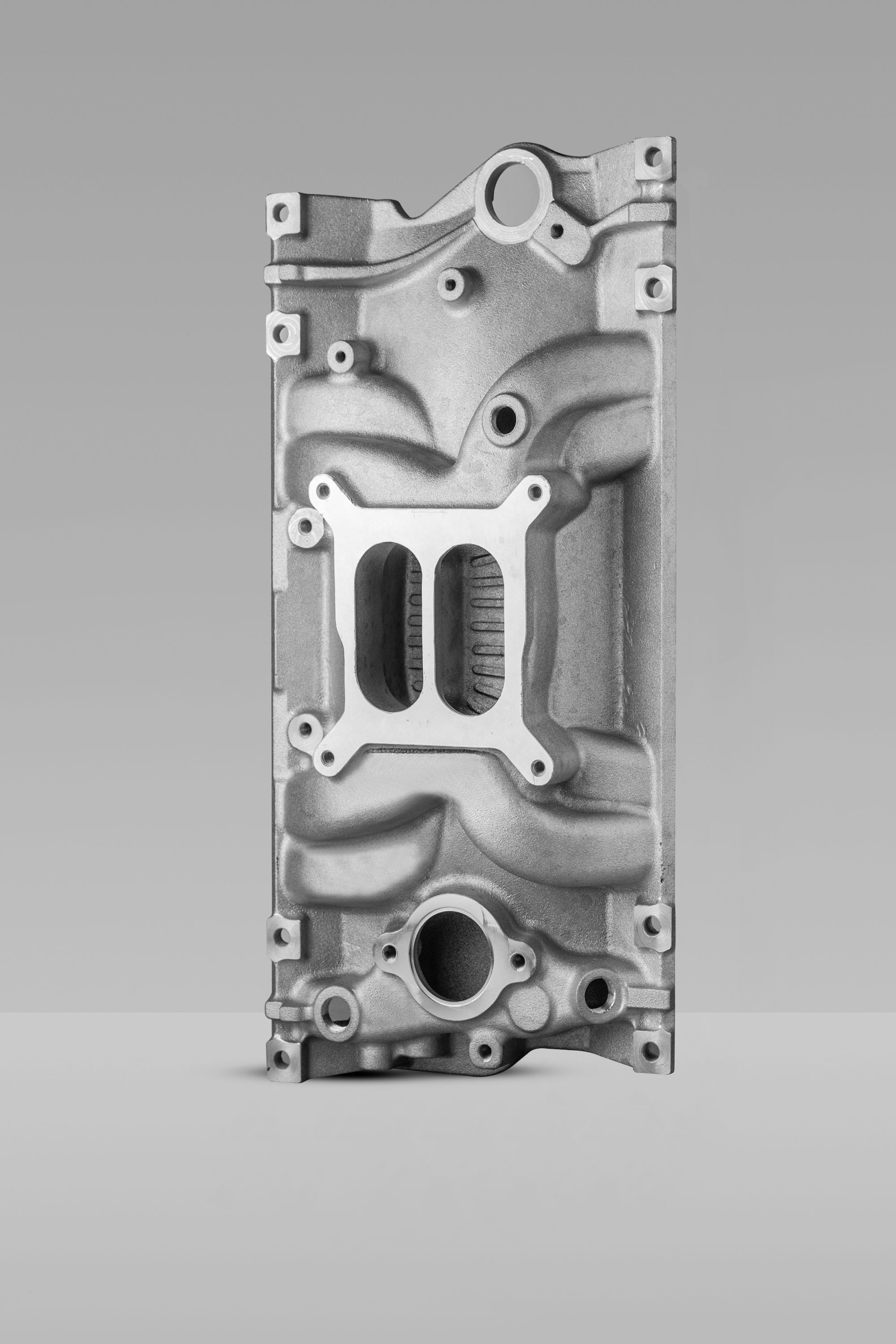
Every millimeter of a throttle body or intake runner is a negotiation between metal and moving air. Precision casting lets us carve internal geometries that subtract turbulence before it forms — not by polishing after the fact, but by holding draft angles, wall thickness, and surface finish to tolerances most foundries won't quote. The result isn't just a smoother part; it's a flow path that behaves the same on the bench, on the dyno, and at the top of fourth gear.
In peak airflow applications, the difference between a good casting and a great one often hides inside the core. A hand-finished port can flow well on a single test piece, yet introduce variance across a production run. Precision casting replaces that guesswork with repeatable internal cores, often printed or machined, that lock in the intended cross-sectional contour. Air sees the design, not the worker's wrist.
We also chase smaller grain structure and tighter dimensional scatter because boundary layers care about microns. A casting that comes out straight — not straightened after heat treat — avoids stress concentrations that distort under thermal cycling. For intake plenums, compressor housings, and intercooler end tanks, precision isn't the luxury tier; it's the only tier that lets airflow predictions survive contact with hot, vibrating reality.
Shedding Pounds Without Sacrificing Strength
The biggest mistake people make when trying to lose weight is cutting calories far too aggressively. Sure, the scale drops quickly at first, but a large chunk of that loss comes from muscle tissue, not fat. To keep your hard-earned strength, aim for a modest deficit of 300–500 calories below your maintenance level. Protein intake becomes non-negotiable: shoot for roughly 0.7 to 1 gram per pound of bodyweight each day. This gives your body the raw material to repair muscle while still burning stored fat for energy.
Your training shouldn't shift to endless cardio or tiny dumbbells, either. Keep heavy compound movements—squats, deadlifts, presses, and rows—as the backbone of your workouts. Yes, you might feel a bit more tired on a calorie deficit, so trimming a few sets here and there is fine. But the load on the bar should stay challenging. If you can lift the same weight for the same reps as before, your body has a powerful reason to hold onto muscle. Add two or three short cardio sessions per week if you need to speed things up, but never at the expense of your lifting performance.
Finally, pay attention to how you feel and perform rather than obsessing over daily scale fluctuations. If your main lifts start dropping week after week, that's a red flag—you're losing strength. Increase calories slightly or reduce training volume until you stabilize. Sleep and stress management play a bigger role than most people realize, as poor recovery raises cortisol and makes fat loss harder. Losing fat without sacrificing strength is a slower process, but it's the only way to end up leaner and just as powerful as when you started.
From Prototype to Production Line
Moving a design from prototype to a full production line rarely follows a straight path. The prototype might work perfectly on a bench, but once you introduce automated assembly, thermal cycling, and operator variability, small design choices start to surface as costly delays. Early conversations with manufacturing engineers usually reveal that the connector placement you thought was convenient is actually impossible to reach with a standard pick-and-place head.
We've learned to treat the pilot run as a reality check rather than a formality. Instead of chasing perfect yields on day one, the goal is to capture every deviation: solder voids, inconsistent torque on fasteners, even subtle changes in how a cable routes through the chassis. Those notes feed back into the design before scaling, not after.
The real shift happens when the team stops asking 'does it work?' and starts asking 'can we build a hundred of these every week without heroics?' That question changes tolerances, test strategy, and even supplier selection. Prototypes forgive almost anything; a production line remembers every shortcut.
Tuning Manifold Geometry for Real-World Gains
When people talk about tuning manifold geometry, they usually mean reshaping the hidden space where data points sit so that distances and angles carry task-relevant meaning. Instead of treating every feature as independent, this leans into the lower-dimensional structure that real-world data often follows. The practical upside appears in models that learn from fewer examples or classifiers that stay reliable when the data distribution shifts a bit.
A common lever is constraining local neighborhoods rather than forcing global coordinates. For instance, penalizing the curvature of a learned embedding can stop the model from folding the manifold into false clusters or tearing apart genuine ones. In fields like sensor calibration or customer segmentation, this kind of tuning often shows up as lower error rates and more stable groupings without adding parameters.
Transfer learning benefits too. When source and target domains share similar manifold geometry, a model tuned to preserve that structure adapts more gracefully. The real-world gain is fewer fine-tuning samples and less sensitivity to noise—the difference between a demo that works in a notebook and a system that survives contact with messy data.
Quality Control That Keeps Engines Breathing Easy
Every filter that leaves the line has already survived a worse day than your engine ever will. We pull samples from each production lot and run them through a salt-dust chamber, a humidity soak, and a pressure-drop curve that mimics 50,000 miles of pollen, brake dust, and wet highway nights. If the pleat spacing drifts by half a millimeter or the adhesive beads unevenly under UV light, the whole batch gets quarantined. No rework, no “good enough” stamps.
The seal gets just as much scrutiny as the media. A filter that flows great on a bench but lets unfiltered air slip past the end caps is a slow abrasive death for cylinder walls. Our QC team checks the urethane lip on every fifth frame with a light-box and a go/no-go mandrel that mirrors the actual airbox opening. No light bleed, no crush, no half-seated gasket. The payoff is a turbo that doesn’t inhale silica at every stoplight and an intake that stays dry enough to keep the MAF sensor honest.
FAQ
Aluminum handles higher heat and pressure without warping, and it allows tighter tolerances on port matching. For builds where intake air temps climb or boost levels rise, it holds its shape far better than molded alternatives.
Yes. We usually start with a single machined or cast sample so you can verify fitment and runner layout on your actual engine. Once you sign off, we move into production tooling only if needed.
We can leave runners as-cast for a textured surface that helps fuel atomization, or we can CNC-finish them to a smooth profile for maximum airflow. The choice often depends on whether you're running carbureted or port-injected setups.
They do. The flanges and plenum walls are designed thicker in high-stress areas, so they resist flexing under positive pressure. We also offer reinforced bosses for MAP sensors, blow-off valves, or methanol injection nozzles.
We use thin-wall casting techniques and selectively machine away material in non-load-bearing sections. That brings the weight close to some composite manifolds while keeping the strength and heat resistance of metal.
Yes, we regularly reverse-engineer from customer-supplied gaskets, flanges, or 3D scans. That allows a direct bolt-on replacement with improved internal volume or runner length.
For a straightforward design with existing tooling, expect around four to six weeks. If we're building new patterns or doing extensive CNC work, it might extend to eight or ten weeks depending on complexity.
Conclusion
A specialized aluminum intake manifold parts manufacturer starts with the metal itself. Aluminum sheds heat quickly, pulling warmth out of incoming air before it hits the cylinders. Cooler, denser air means more oxygen per combustion cycle, which translates into throttle response you can feel. Precision casting keeps interior surfaces smooth and runner transitions clean, so turbulence stays low and peak airflow stays high. At the same time, swapping heavier materials for aluminum cuts pounds from the front end without creating weak spots—critical for vehicles where every gram matters and where rigidity under boost or vacuum must hold up.
Moving from prototype to full production is where geometry tuning really pays off. A good manufacturer iterates on runner length, port shape, and plenum volume to match the engine's intended powerband, not just a generic curve. That means real-world gains in mid-range torque or top-end breathing, depending on the build. Once the design is locked, quality control takes over: leak testing, dimensional scans, and surface inspections ensure each manifold seals properly and delivers consistent airflow. The result is an engine that breathes easier from idle to redline, with the durability expected from a part built to handle heat, pressure, and vibration.
Contact Us
Contact Person: Shelly
Email: [email protected]
Tel/WhatsApp: 8613967667688
Website: https://www.yongyu.com/