

Best 4 Inch Caster Wheels Wholesale for Heavy-Duty Industrial Applications
2026-11-02
For plants where a stalled cart can stop a production line, the difference between standard and heavy-duty mobility comes down to the wheels. CMCL has spent years refining 4-inch caster wheels that hold up under constant load, rough floors, and the kind of abuse only industrial environments dish out. In this guide, we break down what separates bargain casters from ones that actually last—and why wholesale buyers are paying closer attention to the details.
Load Ratings That Hold Up When the Floor Gets Rough
A caster’s stamped load rating means little once the floor stops being smooth. Expansion joints, debris, and cracked concrete turn a rolling cart into a series of small impacts, and that repeated shock can shear bolts, flatten tread, or snap a wheel fork long before the listed capacity is ever reached. Every rating we publish assumes a floor that fights back, so the number you see is not a laboratory best-case—it is the load the wheel can carry mile after mile without the hub wallowing or the bracket twisting under side load.
The difference shows up fastest on casters rated for “perfect floor” use. Push a cart loaded to 80 percent of a smooth-floor capacity across a pitted dock plate and the wheels stop rolling over the rough spots—they start hammering them. That is why our rough-floor ratings are set lower and tested with deliberate shock cycles, not just static weight. A wheel that survives a smooth-floor test may fail in three weeks on a floor with saw-cut control joints, while one rated for rough floors keeps its swivel race tight and its tread unbroken.
For anyone replacing wheels after repeated failures, the usual fix is not a bigger caster—it is a more honest load rating for the surface the cart actually crosses. Choose a wheel whose rough-floor capacity matches the heaviest real load, not the lightest estimate, and the next set should roll past the same cracks without loosening, chunking, or leaving flat spots.
Swivel Action That Doesn't Fight You in Tight Corners
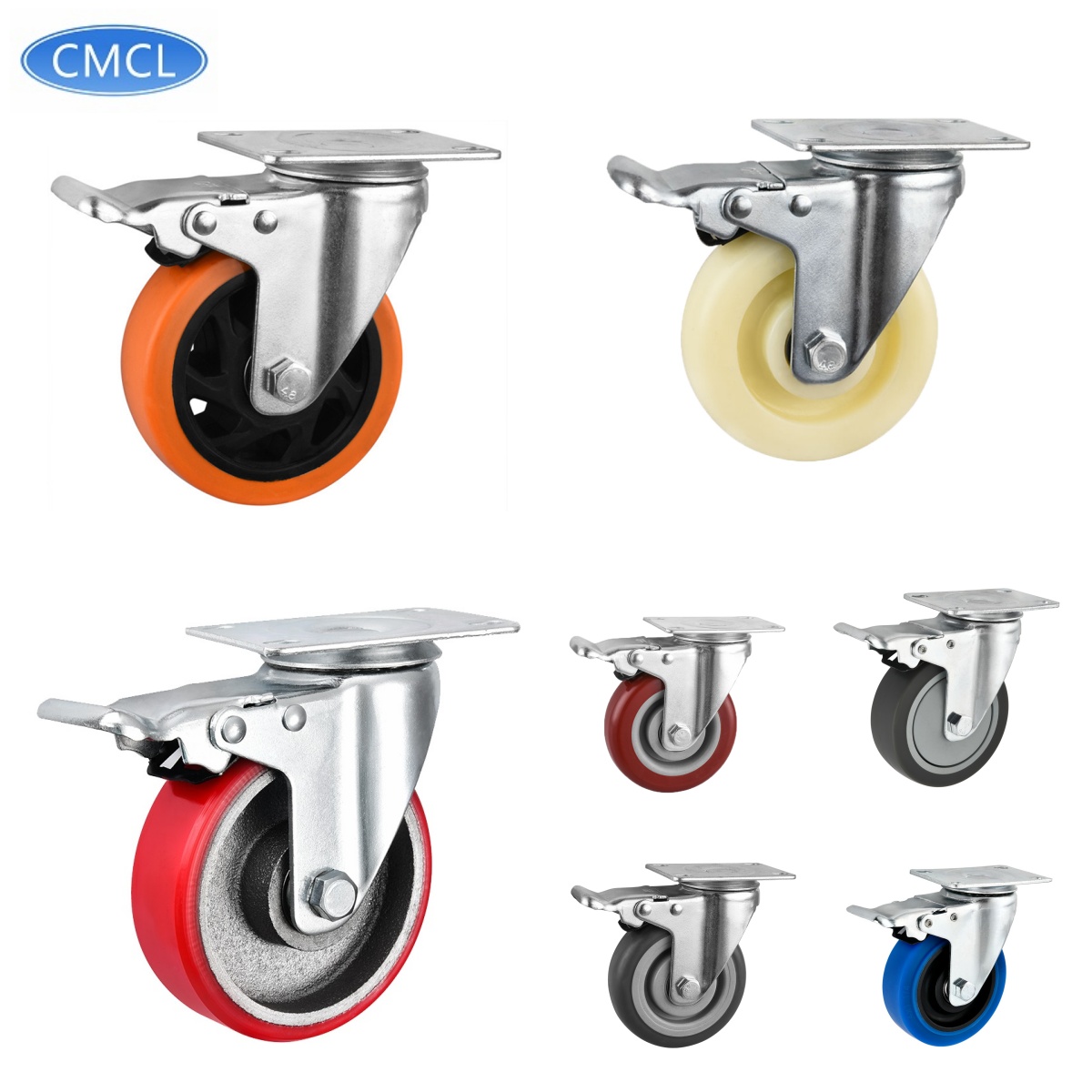
When you're maneuvering through a cramped workshop or threading between shelving units, the last thing you need is a mechanism that resists every turn. This swivel design moves with you, not against you, letting the casters pivot smoothly even when space is barely wider than the equipment itself. Instead of the familiar jerky resistance that forces you to muscle through narrow gaps, the action feels almost weightless, responding to the slightest shift in direction without hesitation.
The key lies in the precision of the bearing assembly and the geometry of the swivel offset. Rather than a simple ball race that binds under load, this setup distributes force evenly across the raceway, eliminating the catch points that normally appear when you change direction at slow speeds. That means you can ease a loaded cart sideways into a tight corner, pause, and roll back out without a fight—no kicking, no yanking, no cursing under your breath.
On the floor, that translates into real time savings. You stop planning routes around obstacles and start trusting the wheels to do the work, even when a door frame gives you an inch of clearance on either side. The swivel feels intuitive, like it anticipates your next move, which is exactly what you need when precision matters more than brute force.
Floor Protection That Keeps Scratches Off the Record
When you're moving a heavy appliance across a vinyl plank floor, the last thing you want is a hairline scratch that turns into a permanent groove. The right floor protection isn't just a sheet of plastic — it's a temporary surface that distributes weight evenly and lets furniture glide without biting into the finish. Look for materials with a low-friction top layer and a non-slip backing that grips the floor without adhesive residue. That combination keeps both the record and the floor looking untouched.
Most damage happens during the first few inches of a move, when a leg or edge digs in before the momentum kicks in. A rigid but slightly flexible protector, like a high-density polycarbonate runner or a double-wall corrugated panel, spreads that initial pressure over a larger area. Avoid thin painter's plastic or cardboard alone — they tear or compress too quickly, leaving the floor exposed exactly where the scratch would start.
For studio sessions where instrument cases, amp cabinets, and mic stands roll in and out daily, skip the one-time drop cloth. Invest in reusable interlocking tiles with a textured surface that channels debris into small pockets so grit doesn't grind against the floor. Pair them with felt pads on any stationary legs, and you've got a setup that protects the record's playback space without turning the room into a construction zone.
Corrosion Resistance for Washdowns and Outdoor Exposure
Washdown areas punish enclosures with high-pressure spray, caustic foam cleaners, and constant dampness. Standard powder-coated steel starts showing rust at cut edges and bolt holes within months. That's why these housings use 316L stainless hardware and a continuous welded seam construction—no lap joints where water can sit. For carbon steel options, a zinc phosphate pre-treatment followed by an epoxy primer and a UV-stable polyester topcoat keeps the substrate sealed even after a scratched surface.
Outdoor exposure adds a different set of problems: morning dew cycles, intense sun, and temperature swings that cause materials to expand and contract. The gasket material is EPDM, chosen because it doesn't harden or crack down to -40°F and stays resilient up to 200°F. A slight roof slope and rear-facing drain channels direct water away from the door opening, so pooled moisture never gets a chance to seep past the seal.
To validate the design, sample units go through a 1,000-hour salt spray test and a cyclic corrosion chamber that alternates between wet, dry, and humid stages. The acceptance criteria aren't just cosmetic—there can be no red rust on the exterior, and the interior must remain dry after a 30-minute hose-down at 1,000 psi from multiple angles. That kind of testing reveals weak points that a spec sheet alone can't show.
Mounting Plates and Stems That Match Your Existing Bolts
The mounting plates are cut with hole spacing that mirrors the bolt pattern already on your fixture, not some generic grid. You keep the hardware you have—probably the bolts that have been there for years and still hold fine—and simply reuse them through the plate. It means no drilling, no inserts, and no rummaging through a bag of mismatched screws.
Stem threading gets the same treatment. Instead of forcing you into a universal pitch that may cross-thread or bottom out early, the stems are matched to common factory bolt sizes and lengths. Run a bolt through the plate and into the stem, and it seats flush without a gap or a wobbly first turn. If your existing bolts are a little worn, they still bite cleanly because the thread engagement is full depth, not shallow.
On a real install, that translates to a direct swap. Remove the old bolts, place the plate, thread them back, and tighten. You are not adjusting hole positions or replacing studs halfway through. The assembly stays aligned while you work, which helps if you are on a ladder or reaching behind a sink. It feels less like adapting a part and more like the part was already there.
Noise Levels That Let Workers Talk Without Raising Voices
Most open offices hover around 60 to 65 decibels, which is roughly the volume of a normal conversation or background music in a busy café. At that level, workers can still hear each other clearly without straining, but the constant hum of keyboards, phones, and distant chatter starts to blur into a steady wash of sound. The ideal range for spoken communication without raising voices actually sits a bit lower—between 50 and 55 decibels. That's about as loud as light rain on a window or the gentle whir of a refrigerator. In that zone, a person's voice carries naturally across a few meters, and colleagues don't need to lean in or repeat themselves to be understood.
Once the noise floor creeps past 65 decibels, people begin to compensate by raising their volume, which in turn pushes the ambient level even higher—a feedback loop that quickly turns a collaborative space into a shouting match. The trick is to introduce enough soft, broadband sound to mask sharp peaks of speech and office equipment, but not so much that the room feels oppressive. Think of the difference between a library and a train station: the library's low rustle of pages and chairs lets two people talk softly at a nearby table without either feeling exposed or overwhelmed. The train station, with its metallic echoes and announcements, forces everyone to shout over the din just to order a coffee.
Practical solutions often involve adding materials that absorb sound rather than reflect it—acoustic panels, thick curtains, carpeted floors, and even bookshelves filled with paper all help to dampen the hard surfaces that bounce noise around. Plants can also scatter and diffuse sound waves, making the space feel calmer without needing heavy machinery. When the background level stays in that sweet spot between 50 and 55 decibels, workers can maintain a relaxed, conversational tone throughout the day, which reduces vocal fatigue and keeps stress levels down. It's not about silence; it's about creating a consistent, unobtrusive backdrop that lets voices rise just enough to be heard, never enough to strain.
FAQ
Heavy-duty 4 inch wheels usually feature forged steel or ductile iron cores with polyurethane or phenolic treads. These materials resist tearing, flat spotting, and chemical damage. The swivel raceways should be double ball bearing or tapered roller bearing for smooth movement under loads up to 1,200 lbs per caster.
Polyurethane handles high loads while protecting floors from marks, and it resists oils and solvents. Rubber offers a softer ride and quieter operation but may not last as long under constant heavy loads. For mixed-use warehouses, polyurethane is often the safer default.
Yes, many wholesale suppliers let you specify plate dimensions, bolt hole patterns, and stem types. Lead times for custom plates usually run 15 to 30 days depending on quantity and machining requirements.
It varies by design, but a well-built 4 inch caster with a steel or iron core and polyurethane tread can support 600 to 1,500 pounds per caster. Always check the manufacturer's dynamic load rating rather than static, since moving loads stress the wheel and bearings more.
Certain models work outdoors or near ovens, but you need to match the tread and bearing grease to the conditions. Phenolic or high-temp nylon wheels handle heat better, while polyurethane with sealed bearings performs well outdoors. Confirm temperature ranges with the supplier.
Most suppliers break pricing at quantities like 100, 500, and 1,000 units. The per-unit cost can drop 15-30% at higher tiers. Some also offer pallet pricing or annual contract discounts for repeat orders.
Look for ISO 9001 manufacturing, RoHS compliance for any plastic components, and sometimes NSF for food-handling areas. For European markets, check for REACH compliance.
Reputable suppliers usually offer sample orders of 2-4 casters, often with the sample cost credited toward your first bulk order. This lets you test floor protection, noise, and mounting fit.
Conclusion
When a facility orders casters by the pallet, the first question is rarely about price alone—it's about what happens when the floors aren't perfect and the loads aren't forgiving. The best 4-inch caster wheels for heavy-duty work carry their rated capacity without wobbling or digging in, even across expansion joints, debris, or uneven concrete. Swivel races that use hardened balls and properly greased tracks let a loaded cart pivot in a tight aisle without the operator muscling the handle. At the same time, the wheel material has to tread lightly: a hard polyurethane or phenolic wheel that holds its shape under a ton of weight shouldn't leave black marks or gouges on epoxy-coated floors. That balance between strength and surface respect is what separates a caster you can sell in bulk from one that triggers warranty calls.
Then there are the less glamorous but equally critical details. Washdown areas and outdoor storage demand corrosion-resistant components—stainless steel or zinc-plated hardware, sealed bearings, and wheels that won't delaminate after repeated chemical exposure. Mounting options matter just as much: plates and stems need to line up with existing bolt patterns so a maintenance crew isn't drilling new holes at 2 a.m. And noise control is not a luxury; in a busy plant, a caster that squeals or rumbles forces workers to shout over it, which wears people down over a shift. A wholesaler that can consistently supply 4-inch casters hitting all these marks—not just one or two—becomes the default source for buyers who can't afford downtime.
Contact Us
Contact Person: Ruby
Email: [email protected]
Tel/WhatsApp: +86 13360379367
Website: https://www.cmcl-casters.com