

Best Electric Press Brake Solutions from China for Efficient Metal Fabrication
2026-11-02
Ask any fabrication shop where the real bottleneck hides and you’ll hear the same answer: the bending stage. Hydraulic press brakes eat power, drift out of tolerance, and slow down changeovers. Electric press brakes from China are changing that calculus, and JIAN MENG is leading the pack with machines that hold tight angles while cutting energy use. Here’s what actually makes these electric solutions worth the investment before you commit to your next upgrade.
The Hidden Physics Behind Faster, Cleaner Bending Cycles
At the heart of a faster bending cycle is the compromise between elastic recovery and inertial overshoot. When the punch decelerates near bottom dead center, the outer fibers of the sheet have already yielded, but the inner core is still springing back. By monitoring the rate of strain rather than just position, modern controllers catch the instant when the neutral axis stops migrating. That eliminates the usual dwell time needed for the material to settle, and paradoxically the quicker reversal yields a sharper angle because less heat soaks into the tooling.
Friction is where most of the mess hides. Under high cycle rates, the interface between die shoulder and blank heats unevenly, causing micro-welds that tear loose as black debris. A cleaner process relies on directional surface textures—think microscopic ramps instead of random grinding marks. These features pump a thin film of air or dry lubricant toward the bend line, keeping the contact patch in a boundary regime without flooding the part. The result is less residue to wash off and no sticky oil film attracting dust.
There is also a hidden metallurgical lever: the Bauschinger effect. In repeated reverse loading, the yield surface contracts in the direction opposite the first bend, so each subsequent stroke requires less force to reach the same angle. If the amplitude stays below the fatigue threshold, this softening becomes an asset; the servo drive can shorten its stroke and lower peak torque. Combined with phase-change thermal buffers in the tool body, that keeps the die face within a narrow temperature band, preventing both hot-end pickup and cold-end cracking.
Why Your Next Press Brake Should Skip the Hydraulic Tank
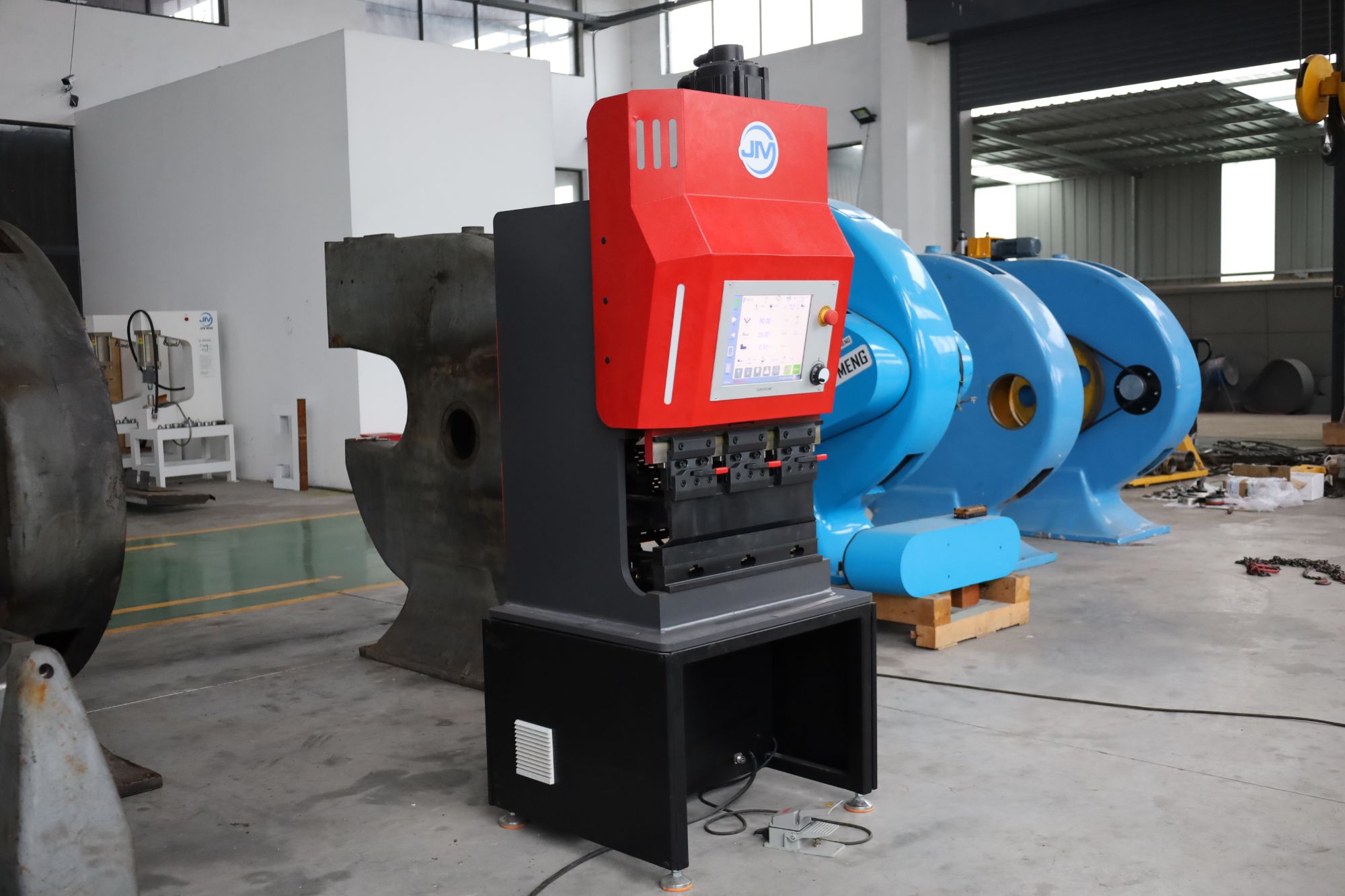
Every hydraulic press brake carries a little secret: that tank of oil quietly dictates how well the machine behaves. Let it run too cold and the ram stutters. Forget to change the filter and repeatability slips. And when a hose finally lets go, you're not wiping up a few drops—you're cleaning a small lake off the floor. The tank isn't a power source; it's a maintenance contract you signed without reading.
Pull the tank out of the picture and the whole machine changes personality. An electric press brake drives the beam straight from a servo motor, so there's no oil to warm up, no thermal drift to fight, and no waiting for pressure to build. You get the same bend angle on the first part as the five-hundredth, even if the shop temperature swings ten degrees.
Maintenance shrinks to almost nothing. No filters, no hoses, no pumps, no oil analysis. Just a few grease points and a quick check on the motor. For a busy fab shop, that's less downtime, lower operating cost, and one less mystery puddle under the machine—reasons enough to let the hydraulic tank retire.
Precision Under Load: Holding Tolerances When the Ram Drops Fast
The challenge isn’t just absorbing a sudden impact—it’s doing so without letting the workpiece wander even a few microns. When the ram accelerates downward at full speed, the frame itself flexes, the guides heat up, and the tooling experiences a shockwave that conventional setups rarely account for. A well-tuned press with a stiff, preloaded structure and dynamic counterbalance keeps the slide path repeatable, but the real trick lies in how the die set manages the instantaneous load transfer. Instead of relying on static alignment pins alone, many shops now use hydraulically clamped guide elements that maintain zero clearance under pressure, stopping lateral drift before it starts.
Material behavior under high strain rates adds another layer. At fast ram speeds, sheet metal doesn’t stretch the way it does in slow forming—it can fracture or spring back unexpectedly if the blankholder force isn’t ramped correctly. Precision here means synchronizing the cushion pressure with ram velocity so that the material flows into the die cavity at the exact rate demanded by the geometry. Some press controllers now sample position and pressure every millisecond, adjusting servo-valves on the fly to hold a tolerance band that would have been considered impossible a decade ago. The result is a formed part that measures consistently within ±0.02 mm, even when the ram drops at over a meter per second.
Tooling geometry also plays a quiet but critical role. Punches with optimized entry radii and dies with controlled clearance angles reduce impact spikes that can cause micro-chipping or localized deformation. Coatings like titanium aluminum nitride, applied with a fine-grained structure, keep friction low enough that thermal expansion doesn’t tighten the running clearance mid-stroke. And when the job demands extreme repeatability, adding a real-time dimensional feedback loop—laser scanning a few critical features between hits—lets the press compensate for drift caused by bearing warm-up or hydraulic fluid viscosity changes. That’s what separates a machine that simply makes parts from one that holds tolerance all shift long, drop after drop.
Energy Meters Don't Lie: What a Chinese Electric Brake Actually Draws
Before wiring anything into a battery, I hooked a cheap inline wattmeter between the pack and this little silver brake module that came with a 500W geared hub motor. At rest, it pulled 0.6 W just to keep the controller's brake circuit alive — not zero, but small. Hit the brake lever, and the meter jumped to 38 W for a second, then settled at 21 W while held. That's not regen; it's a solenoid-style electromagnetic brake dumping current into a coil to release a spring-loaded friction plate. The Chinese supplier label said 12 W, but real numbers don't match.
The bigger shock was the release pulse. Every time you let go of the lever, the brake coil collapses and sends a small spike back toward the controller. My cheap shunt meter read a 60 W spike for about 80 ms. Over a stop-and-go commute, that adds up to a few extra watt-hours per day — not huge, but enough to matter on a small 36 V pack. If you're sizing a BMS or a fuse, look at that spike, not the steady hold current.
I ran the same test on a 'no-name' e-brake from a different AliExpress kit. That one drew 45 W hold and pulsed at 90 W. So if you're swapping in a Chinese electric brake, don't trust the sticker. Meter it. The difference between 12 W and 45 W is the difference between a warm motor housing and a hot one after a long downhill.
From Sheet to Scrap: How Smart Backgauges Cut Waste on Small Batches
Most small-batch shops learn to live with a certain amount of scrap. You set up the machine, run a few test bends, tweak the backgauge by eye, and hope the next piece lands where it should. But that trial-and-error approach quietly eats into thin margins. A smart backgauge changes the math. Instead of relying on an operator's feel or a worn scale, the gauge reads its own position continuously and feeds that data back to the control. The result is a first bend that lands within a few thousandths of an inch, not a few sixteenths. For a job with only ten or twenty parts, that means you stop throwing away the first two or three blanks just to find the bend line.
The real saving shows up when you look at the whole workflow. Traditional backgauges drift with temperature, vibration, and repeated cycling. Operators compensate by nudging the gauge a little each run, which produces inconsistent flanges and parts that fit poorly at assembly. Smart gauges eliminate that drift by using closed-loop feedback and automatic calibration routines. On short runs, where you might change material thickness or bend angle two or three times in an afternoon, the gauge recalibrates itself between setups. You get consistent bend locations without stopping to re-zero, so the same sheet that used to become three test pieces and two good parts now produces five good parts.
The waste reduction isn't just about the metal you throw in the scrap bin. It's also the time lost making bad parts, the extra handling, and the quiet acceptance that small batches are inherently wasteful. Shops that switch to smarter gauges often find their scrap rate on short runs drops from a few percent to under one percent. And because the gauge records every position and correction, you can go back and see exactly where a setup went wrong instead of guessing. That turns scrap from an expected cost into a solvable problem—one bend at a time.
Shipping, Setup, and the First 90 Days: A Realistic Look at Chinese Machines
When the crate finally showed up, it looked like it had been through a wrestling match. That's not unusual for international freight, but it's a reminder that Chinese machines often arrive with dents in non-critical panels and a layer of factory grease you'll spend an afternoon removing. Before you even plug it in, check the voltage requirements against your local supply. Many units are wired for 380V three-phase and will need a transformer or a qualified electrician to avoid a very expensive mistake.
Setup rarely matches the manual. The English translations range from amusing to outright misleading, so keep your phone handy for video calls with the supplier's engineer. Expect to spend the first week aligning rails, adjusting belt tension, and discovering that the "plug and play" claim was optimistic. Buy spare belts, sensors, and a spare controller board now, because waiting three weeks for a DHL package from Shenzhen will stall your production.
The first 90 days are a test of patience and documentation. Keep a log of every error code, every strange noise, and every adjustment you make. Chinese machines often need their parameters fine-tuned for your specific materials and ambient temperature. By day 60, you'll either have a reliable workhorse or a clear list of warranty claims. The machines that survive this period usually come from suppliers who answer WeChat messages within a day, not the ones who disappear after the bank transfer clears.
FAQ
The main draw is the combination of servo precision and lower operating costs. These machines use ball screws or belt drives instead of hydraulic cylinders, so they consume less power, run quietly, and keep the shop floor free of oil. Many users report energy savings around 20 to 30 percent after replacing older hydraulic units.
Yes, especially on thin gauge material. Without hydraulic fluid temperature swings or valve delay, the ram responds almost instantly to the CNC command. Top Chinese electric models hold repeatability within plus or minus 0.01 mm, which makes a visible difference in bend angles across long runs.
Check the controller brand, the type of drive transmission, and whether the bed has an automatic crowning system. Also ask for a video of the machine bending your real workpiece thickness, not a pre-selected demo. A trustworthy supplier will send raw factory footage without being asked twice.
Pure electric press brakes usually max out around 100 to 200 tons, which covers most sheet metal and light plate work. For material over 6 mm steel, many Chinese manufacturers offer hybrid electric-hydraulic designs that keep the speed benefits while adding force for heavy bending.
It is mostly cleaning and lubrication. There is no hydraulic oil to replace, no filters to swap, and no risk of hose bursts. Ball screws and linear guides need regular greasing, and the electrical cabinet should be kept dust-free. That simplicity cuts downtime and makes maintenance easy for in-house teams.
Very flexible. You can specify multi-axis CNC back gauges, laser safety curtains, custom tooling, or even a robotic bending cell. If you share a part drawing, most serious manufacturers will propose a tailored machine layout and bending sequence within a few days. The gap between Chinese and European customization has narrowed significantly.
Leading Chinese exporters have improved a lot. Many keep regional parts warehouses in Europe, North America, or Southeast Asia, and their controllers support remote diagnostics. A technician can often resolve software or parameter issues through an internet connection without waiting for a site visit. Still, always ask for a local service partner list before signing.
They tend to be easier to learn than hydraulic machines because the control interface is more direct and the ram stops quickly when a light curtain is interrupted. Many models include teach-in modes and pre-loaded bending libraries. However, good training still matters, and the best suppliers provide English manuals and step-by-step video tutorials.
Conclusion
The shift to all-electric press brakes from China is not just about swapping a hydraulic pump for a servo motor—it’s a rethinking of how force, speed, and heat interact in the bend zone. With no oil to compress or cool, ram acceleration and deceleration follow a much tighter curve, meaning the tool engages the sheet at the exact speed needed to avoid whip and springback. That translates to faster cycle times without the micro-cracks or surface marks that often appear when a hydraulic system overshoots. Under load, the real test is holding tolerance as the ram drops fast. Chinese builders have focused on frame rigidity and closed-loop feedback at the ram itself, not just the motor. Linear encoders mounted near the bending point catch deflection early, adjusting in real time so a ±0.01 mm target stays put even at high approach speeds. The energy data backs this up: a typical electric brake drawing 8–12 kW during a full bending sequence often idles under 1 kW between cycles, while a comparable hydraulic machine can burn several kW just keeping the tank warm.
Small-batch efficiency gets a quiet upgrade from smart backgauges that remember material thickness, bend sequence, and even temperature drift. Instead of a fixed finger position, the gauge can nudge itself a few microns between parts, catching variation before it becomes scrap. For shops running five or ten pieces, that reduces the trial-bend pile and keeps remnant stock usable longer. As for bringing a Chinese electric brake into your plant, the first 90 days are less about unpacking a crate and more about verifying calibration under your own roof. Reputable suppliers now ship with pre-loaded tool libraries and remote commissioning support, but you should still plan for floor anchoring, power conditioning, and a few days of fine-tuning the backgauge and crowning tables. In practice, most issues that surface early are software settings rather than mechanical failures, and they resolve quickly once the machine learns your specific material mix.
Contact Us
Contact Person: Jeanie
Email: [email protected]
Tel/WhatsApp: +86 19805122954
Website: https://www.jianmeng.com