

RCCB Manufacturer Tips for Choosing Safer Circuit Protection
2026-11-02
Selecting a residual current circuit breaker (RCCB) often feels like a checkbox exercise—until a fault current tests your decision. Drawing on real-world manufacturing insight, ETEK shares the nuances that separate genuinely safer protection from merely adequate components. From trip sensitivity myths to installation mismatches, this guide covers what spec sheets won’t tell you.
RCCB Types: Don’t Settle for the Default
Most panels ship with the same generic RCCB, but the range of available types means you rarely have to accept that one-size-fits-all choice. You have options like Type AC for simple resistive loads, Type A for circuits with pulsating DC from electronics, and Type B for installations with three-phase rectifiers or EV chargers. Choosing the right variant is less about brand loyalty and more about matching the residual current behavior to what’s actually plugged in downstream.
The default unit often assumes a clean sinusoidal fault, which is not how modern loads behave. A variable-speed drive or a washing machine with an inverter can generate smooth DC fault currents that a standard Type AC will ignore completely, leaving a false sense of protection. Swapping to a Type A or F can close that gap without a complete panel redesign, and the cost difference is usually minimal compared to the risk of an undetected earth fault.
Before buying another “just like the old one” replacement, check what the circuit actually serves. A workshop with three-phase motors wants a Type B, while a lighting-only branch may be fine with a selective or delayed version to avoid nuisance tripping. The point is not to over-spec every circuit, but to stop assuming the factory default is good enough when the technology has already moved past it.
The Residual Current Rating Sweet Spot: Avoiding Over- and Under-Protection
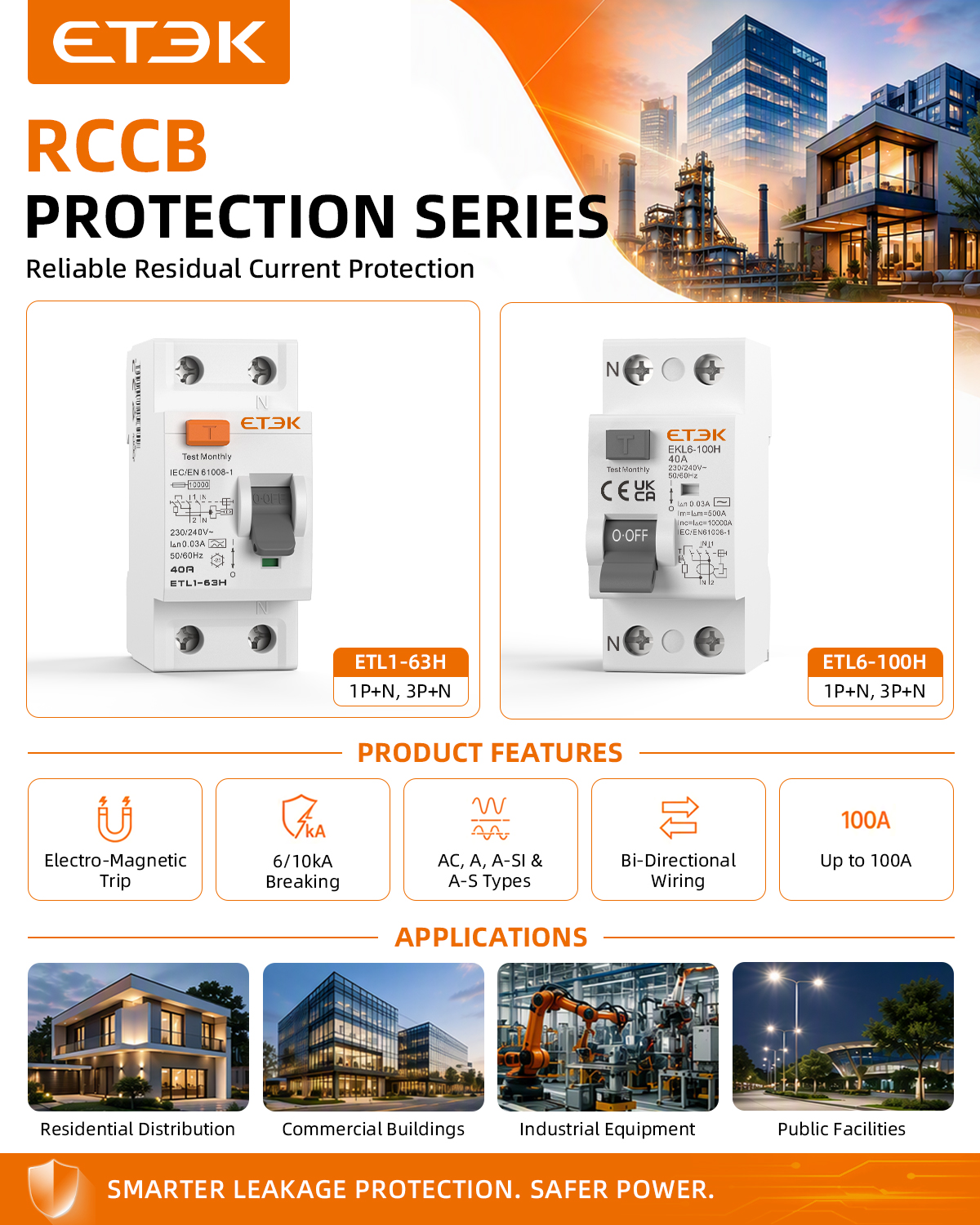
Finding the right residual current rating often feels like tuning an old radio—too far one way and you get static, too far the other and the signal disappears. A device set at 10 mA may trip when a refrigerator compressor kicks in, while a 300 mA unit can sit silent through a fault that already has someone tingling at the switchboard.
The practical sweet spot for most final circuits remains 30 mA because it sits just below the threshold where muscles lock and just above the leakage currents that normal appliances produce. But this isn't a universal rule. Workshops with handheld power tools, wet areas, or longer cable runs can shift the balance enough that 10 mA becomes viable, whereas distribution boards feeding multiple circuits might legitimately use 100 mA or 300 mA as a fire-prevention backstop rather than a shock-prevention device.
Overlooking this distinction leads to two costly mistakes: over-protection that ends with bypassed or disabled RCDs because they trip too often, and under-protection that leaves a circuit legally compliant but physically dangerous. Matching the rating to the circuit's actual leakage profile—not the label on the breaker—is how you land in the sweet spot.
Certification Marks That Actually Prove Something
Plenty of certification programs are little more than paid badges, but a handful force candidates to demonstrate actual skill under pressure. The Red Hat Certified Engineer (RHCE) exam, for instance, drops you into a broken Linux environment and expects you to fix it within a time limit—no multiple-choice guesses, no shortcuts. The Offensive Security Certified Professional (OSCP) goes further, requiring a 24-hour hands-on penetration test followed by a detailed report. When an employer sees one of these, they’re not just seeing a certificate; they’re seeing proof you can work when it counts.
Even outside deeply technical fields, certifications with strict experience prerequisites tend to carry more weight. The Project Management Professional (PMP) demands thousands of hours leading projects before you can even sit for the exam, and then the test itself focuses on scenario-based judgment rather than rote recall. Compare that to a two-day seminar certificate that anyone can buy. The difference is obvious: one represents a body of verified work, the other a receipt for attendance. A certification proves something only when the path to earning it is harder than the marketing around it.
Installation Conditions That Can Silently Disable an RCCB
Even a correctly rated RCCB can end up providing zero protection if the installation itself undermines its ability to sense a fault. One common silent killer is a shared neutral conductor between circuits. When neutrals from different RCCB-protected circuits are tied together downstream, normal return currents can split unevenly. The resulting imbalance can either prevent the RCCB from tripping on a genuine earth fault or, worse, cause nuisance tripping that leads someone to bypass the device entirely.
Another overlooked condition is excessive cable length. Long runs between the RCCB and the load increase capacitance to earth, especially in modern installations with electronic ballasts or variable speed drives. During switching events, this stray capacitance can leak enough current to hold the RCCB near its threshold, desensitising it to small but dangerous faults. In some cases, the leakage is so steady that the RCCB simply fails to respond until the current is far above its rated trip level.
Finally, poor earthing arrangements can disable an RCCB without any visible sign. If the protective earth path is high resistance or accidentally bonded to a neutral at a second point, a fault may not produce the current imbalance the RCCB expects. The device sits inert while metal enclosures rise to hazardous voltages. Regular loop impedance testing at the furthest socket can reveal such hidden degradation before it becomes a fatality.
Why Modern Loads Require a Different Kind of RCCB
The old assumption that a residual current device only needs to catch obvious earth faults no longer holds up. Today's homes and workplaces are filled with electronics that don't just draw power in a clean sine wave—they chop it, smooth it, and push harmonics back into the circuit. Variable speed drives, LED lighting arrays, and even high-efficiency HVAC units can create small, persistent leakage currents that a standard AC-type RCCB simply ignores. This isn't a flaw in the wiring; it's the natural behavior of modern power supplies. If the protection device can't see those subtle signals, it leaves equipment and people exposed to a slow-burning risk that never trips an alarm until something fails outright.
Another shift comes from the way we use electricity now. A decade ago, a single RCCB covering an entire floor was considered adequate. But with electric vehicle chargers, solar inverters, and heat pumps becoming common, the fault profile changes dramatically. These loads can inject DC components into the residual current, which blinds many older devices. An RCCB designed only for smooth AC faults may sit silent while a DC-biased leakage grows. That's why the industry has moved toward Type A, Type F, and Type B devices—not as a marketing gimmick, but because the actual waveform of a fault current looks nothing like the textbook example from decades past.
Ignoring this shift carries a practical cost. When a standard RCCB fails to operate on a real fault, the first sign is often damaged equipment or nuisance tripping elsewhere in the system. Electricians get called back, customers lose trust, and the root cause remains hidden because the protective device was never the right tool for the job. Modern loads demand a residual current device that understands the messy, non-linear reality of contemporary power electronics. Choosing the correct type isn't about chasing the latest specification—it's about matching the protection to the actual behavior of the loads already installed in the building.
The Monthly Test Button: Your Cheapest Safety Habit
Most people walk past the same small button on their wall or ceiling every single day without giving it a second thought. It’s not expensive to press, it doesn’t require any tools, and it takes less time than brushing your teeth. Yet that little test button on a smoke or carbon monoxide alarm remains one of the most neglected safety habits in the average home. The irony is hard to miss: we spend hundreds on smart security systems and insurance policies, but the one action that could actually wake us up in a real emergency often stays forgotten for months, sometimes years.
Pressing the test button once a month does more than just confirm that the battery hasn’t died. It forces you to listen for the exact sound you’ll need to recognize half-asleep at three in the morning. It also reveals early signs of trouble—dust buildup, a faulty sensor, or a loose connection—that only show up when the alarm actually tries to sound. Many detectors look perfectly fine from the outside, with a steady green light, but go silent when they’re supposed to scream. A monthly press catches that failure before it becomes a tragedy.
The best part is that this habit costs nothing except a few seconds of your time. No subscription, no installation, no phone call to a professional. Just pick a day that’s already part of your routine—the first morning of the month, the day you pay rent, the day you change your calendar page—and link the button press to it. Put a note on your bathroom mirror or set a recurring reminder. Once it becomes automatic, you’ll stop noticing the effort and start noticing the peace of mind. That little plastic button is probably the cheapest insurance policy you already own.
FAQ
The residual operating current rating matters most. For personal protection, 30mA is standard, but environments with high leakage—like workshops with many motors—may need selective coordination using 100mA or 300mA units upstream. Also look at the trip curve: type A handles AC and pulsating DC, while type B covers smoother DC from solar inverters or EV chargers.
Breaking capacity tells you the maximum fault current the RCCB can interrupt without welding its contacts. In a home, 6kA is usually enough, but commercial panels near transformers may see 10kA or more. If the rating is too low and a short circuit occurs, the device can fail catastrophically instead of clearing the fault.
High heat accelerates aging of internal components and can make the trip threshold drift. Most RCCBs are calibrated for 25°C to 40°C. In outdoor kiosks or hot machinery rooms, choose a model with a wider operating range or add ventilation. Cold rarely causes false trips, but condensation can, so look for sealed enclosures in humid areas.
Mixing neutral conductors from different circuits downstream of separate RCCBs is a classic error—it causes nuisance tripping and leaves some circuits unprotected. Another is connecting the incoming supply to the load terminals. Always follow the wiring diagram, keep the neutral isolated, and test with the built-in button after any change.
In remote or hard-to-reach installations like telecom towers, street lighting, or irrigation pumps, manually resetting a tripped RCCB is expensive and slow. An auto-reclosing model checks for a sustained fault and restores power once the leakage clears. For normal indoor use, a manual reset is fine and avoids masking recurring problems.
Look for third-party marks like CE, UKCA, or an independent lab's certification number printed on the device. Don't rely on the seller's claim alone. You can cross-check the certificate on the certification body's database. Also request the manufacturer's type test report for the exact model, not just a similar one.
Type AC only detects sinusoidal AC leakage—fine for old resistive loads. Type A adds pulsating DC, which appears in many modern appliances with rectifiers. Type B is needed for smooth DC leakage from solar arrays, EV charging, or UPS systems. Choosing the wrong type can mean no trip when a real earth fault occurs.
Yes, because the neutral switching matters. A 2-pole RCCB isolates both live and neutral for single-phase, which is safer for maintenance. In three-phase systems without neutral, a 3-pole unit works, but if there's a neutral, use a 4-pole to avoid a floating neutral that can cause overvoltage on one phase.
Conclusion
Choosing an RCCB isn't just about picking a part number from a catalogue. The first trap is settling for the default type. AC-type units fail on DC leakage from modern electronics, while A-type or F-type handle rectified loads better, so match the device to what actually runs downstream. Equally important is the residual current rating: a 30mA trip protects people, but going higher for nuisance tripping often leaves faults simmering. Don't assume a lower rating is automatically safer either—selective coordination with upstream breakers can get messy. Look for certification marks from independent labs like VDE, SEMKO, or KEMA; these indicate tested endurance and trip performance, not just a CE sticker that anyone can self-declare.
Installation conditions matter more than most electricians admit. Dust, moisture, or a loose neutral can silently disable an RCCB, so check the IP rating and wiring tightness before trusting the device. Modern loads like variable-speed drives and LED banks generate high-frequency leakage that older RCCBs miss entirely, meaning you need a type B or B+ for real protection. Finally, that monthly test button is your cheapest safety habit—press it regularly and watch for a clean trip and reset. If it feels sticky or fails to latch, replace the unit immediately. A well-chosen, properly installed, and routinely tested RCCB is the difference between nuisance downtime and a genuinely protected installation.
Contact Us
Contact Person: Andy
Email: [email protected]
Tel/WhatsApp: +86 13356133008
Website: https://www.etek-china.com/