

Sandpaper Jumbo Roll Manufacturer: Key Factors for Selecting a Reliable Partner
2026-09-16
Selecting a sandpaper jumbo roll manufacturer rarely comes down to price alone. The real test is whether your supplier can consistently deliver uniform grain distribution, stable backing tension, and reliable splice-free rolls under demanding production schedules. At SHENZHEN SUN ABRASIVES, we've seen how the right manufacturing partner prevents downtime and rework—and how the wrong one quietly erodes margins. Before you commit, here are the key factors that separate dependable partners from costly compromises.
Grit Consistency Checks That Separate Serious Suppliers
Most suppliers can point to a single impressive test report, but the ones worth keeping dig into repeatability across production runs. A serious grit supplier will run laser diffraction on every batch, not just a periodic sieve check, and then plot the D10, D50, and D90 values on control charts. If the span starts drifting outside a pre-agreed band, they catch it before the material ever leaves the warehouse. That kind of internal trigger is what separates a vendor who reacts to complaints from one who prevents them.
Beyond particle sizing, look at how they verify hardness and chemistry. A single bulk hardness number hides a lot; better suppliers test multiple fractions and report Knoop or Vickers values with the exact load and dwell time used. They also run XRF or ICP on incoming raw stock and again on the finished grit, with tolerance limits tied to the intended application rather than a generic data sheet. If the supplier keeps retained samples from each lot and can pull them within a day for a side-by-side comparison, that's a strong signal their consistency checks are real, not just for show.
Backing Materials That Survive Wet Sanding Without Delaminating
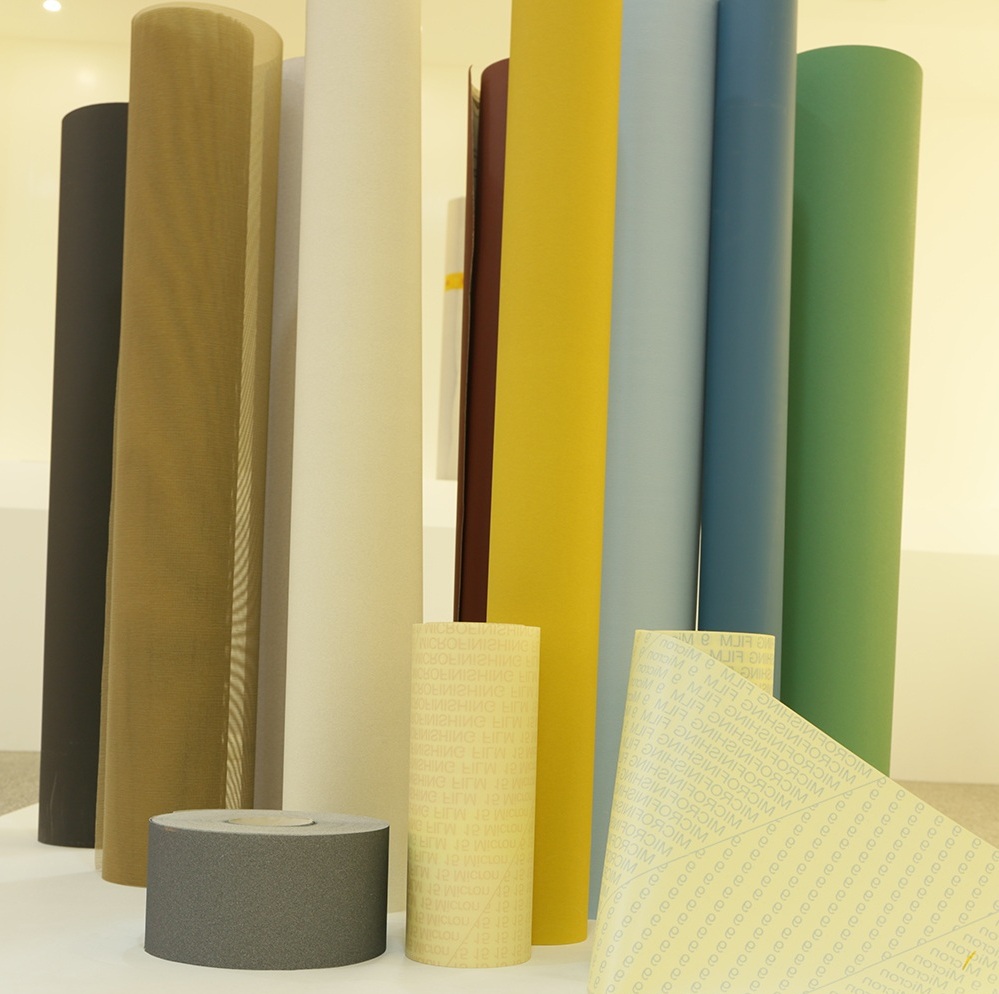
Not all backings handle prolonged water exposure well. Standard paper swells and separates at the edges, but resin-saturated latex paper and polyester film maintain their structure. The real issue isn't just a waterproof surface coating; it's how the adhesive layer between the backing and the abrasive grain holds up when moisture seeps in. Quality wet/dry papers use a fully saturated base that stays dimensionally stable even after soaking, so the abrasive layer doesn't peel away in sheets.
Film backings, especially polyester, are often overlooked but perform exceptionally well in wet sanding. They don't absorb water, so there's no swelling or fiber lifting. This prevents the abrasive coating from separating at the edges, a common delamination point. For curved or contoured surfaces, a thinner film can flex without cracking or splitting, keeping the abrasive layer intact through repeated wet-dry cycles.
Cloth backings with a waterproof treatment can also work, but only if the treatment fully penetrates the weave. If water reaches the inner fibers, they can swell and cause the resin bond to crack. Look for tightly woven, fully saturated cloth or switch to polyester film for immersion or high-humidity work. The goal is a backing that stays flat and firmly bonded when wet, not just one that repels water on the surface.
Custom Slitting Tolerances That Don't Add Weeks to Your Order
When you ask for a non-standard slit width or a tighter edge condition, the assumption is often that the order will sit in a queue while special tooling is sourced. That is not how our line runs. Custom tolerance bands are treated as part of the standard setup routine, so holding a width to ±0.005 inch does not automatically extend your lead time by several weeks.
The reason is straightforward: we use in-line measurement and a broad inventory of slitting knives that covers most narrow and wide combinations. Adjustments happen while the coil is moving. If a strip begins to drift toward the edge of your specified range, the operator corrects it immediately instead of stopping the line, re-running material, or waiting for a secondary inspection to clear the job.
What you receive is a roll that matches your downstream process without the extra queue time. Roll-to-roll consistency stays the same as a standard order, but the width, burr, and edge condition are matched to your actual application, from light gauge foil to heavier sheet steel.
Joint Strength and Splice Frequency in Continuous Runs
In long continuous runs, the tensile capacity of the system rarely hinges on the base material alone. Each field splice or vulcanized joint introduces a localized discontinuity where load transfer depends on adhesion, fastener grip, or interlocking geometry. A single substandard joint can reduce the effective working tension by 15–30% compared with an unbroken section, even when the base material specifications exceed the design load.
Splice frequency compounds the problem. The more joints packed into a given length, the higher the probability that at least one will underperform under dynamic or thermal cycling. This is not merely a statistical concern; adjacent splices can interact, creating stress concentrations that migrate with repeated flexing. For most heavy-duty applications, limiting splices to one per 200–300 feet of run and staggering them across adjacent plies or conductors remains a practical upper bound.
Installers often try to maximize continuous lengths to avoid splices altogether, but transport and access constraints make that unrealistic. The better approach is to treat each splice as a designed element rather than a field fix: specify precise overlap lengths, cure times, and alignment tolerances, and verify joint strength through pull tests on representative samples before the full run is placed in service.
Test Reports You Should Actually Ask to See
Most teams only share the happy-path results, but the real story hides in the reports nobody volunteers. Ask for the flaky test log — if you see the same three tests failing intermittently for weeks, that's not a testing problem, it's a design smell. Then grab the performance trend report, not just the latest spike test. A gradual climb in response time from 180ms to 420ms over six months gets buried in green dashboards until launch day. Finally, demand the coverage gap map. Not the overall percentage, but the heatmap showing exactly which modules have zero assertions. That's where your next production incident is already growing.
The accessibility report is another one that gets conveniently left out of the summary email. Run an axe-core scan on a real user flow and you'll find unlabeled icon buttons, color-only error states, and focus traps that never made it into the sprint demo. If nobody can produce that report in under ten minutes, your release checklist is theater. Same goes for the cross-browser visual diff — not screenshots, but pixel-level comparisons. A button that renders 2px off in Safari won't break your unit tests, but it will cost you a week of customer complaints.
And don't forget the data integrity report. When was the last time someone verified that the backup restore actually works, or that the soft-delete flag doesn't cascade into a foreign key orphan? These reports are boring until they're not. If the answer to "can I see that report right now?" is a long pause or a vague promise, treat it as a red flag. Healthy projects make these artifacts boring to produce, not exciting to discover.
How Manufacturers Handle Sudden Demand Without Stalling Your Line
When a sudden spike in orders hits, the instinct is to crank up production speed—but that's often the fastest way to grind your line to a halt. Savvy manufacturers start by mapping the exact bottleneck before touching a single dial. Maybe it's a curing oven that can't run hotter, or a packaging station that only fits two operators. Once you know where the constraint lives, you can reroute non-critical steps, run parallel batches, or temporarily borrow capacity from a slower sister line instead of overloading the whole floor.
Another trick that keeps lines flowing is pulling demand forward on standard components. If your product shares a common chassis, bracket, or firmware load, you can pre-stage those parts during the lull before the rush. That way, when the big order lands, your team only has to handle the final assembly variations. Pair this with a simple visual signal—like a color-coded kanban card or a dry-erase board by the line—so everyone sees at a glance which variant is next, and you avoid the chaotic switchovers that eat up hours.
Finally, don't mistake overtime for a strategy. Short bursts of extended shifts can absorb a demand wave, but the real buffer is cross-trained workers who can float to wherever the pressure is highest. Instead of hiring temps for one frantic week, shift your own people from low-priority tasks and let them rotate through the bottleneck station in ninety-minute sprints. This keeps quality steady, lowers the injury risk from fatigue, and leaves your line ready for the next surprise instead of nursing a backlog of rework.
FAQ
Check how transparent they are about their backing weight, grit distribution, and bond type. A dependable maker will provide full roll-width sample data and tolerance sheets without hesitation, rather than hiding behind generic claims.
Ask about their resin and adhesive systems under high heat. A partner worth keeping will explain how they adjust bond hardness for different materials like wood, metal, or composites, and will have real failure analysis records to back it up.
Uneven coating thickness across a jumbo roll leads to premature loading and inconsistent finishes downstream. The best suppliers measure coating weight at multiple points across the web and share that data openly, so you never discover the problem after slitting.
It is not just about where the abrasive grain comes from, but whether the manufacturer can trace every batch back to specific lots of backing and resin. That traceability becomes essential when a slitting line reports a sudden change in performance or durability.
Ask for their in-line inspection methods, such as optical surface scanners or beta gauges for coating weight. A trustworthy factory will discuss reject rates, rework loops, and how they isolate non-conforming rolls before they ever leave the floor.
Look for unlabeled raw material bins, poor climate control in the coating area, or inconsistent tension on the unwind stands. These are signs that the final roll may vary from one edge to the other, no matter how polished the sales pitch sounds.
A manufacturer who can adjust grit sequence, backing flexibility, or coating type for your specific sanding application has deeper process control. If they only push catalog items and resist minor changes, they are likely constrained by equipment or material limitations.
Request their actual production schedule, not just promised dates, and ask how they handle a sudden 20% increase in demand. Reliable partners will show you their bottleneck analysis and safety stock policy for common jumbo roll sizes, rather than offering vague assurances.
Conclusion
When you're sourcing jumbo rolls, the first thing worth pressing a supplier on is how they verify grit consistency. A serious manufacturer will walk you through their incoming abrasive checks and batch sampling, not just promise a uniform scratch pattern. Ask what happens when a lot fails—do they quarantine it or quietly blend it in? Then look at the backing. Wet sanding punishes weak paper or cloth, so you want proof of resin bonding and edge stability under soak tests. Delamination at the edges is a telltale sign of shortcuts. Slitting tolerance also matters more than most buyers assume. If your line runs at high speed, a wobble of half a millimeter can cause tracking drift and waste. The best suppliers set tolerance bands around your core specs and lock them with a written process, not a handshake.
Joint strength and splice frequency are invisible until they shut you down. Ask how many splices per roll you should expect and what tensile test they run on each joint. A clean, thin splice that holds through tension changes beats a bulky one that prints through. Test reports are your leverage—request the actual abrasion test data, backing tensile results, and coating weight per square meter, not a summary sheet. Finally, watch how a manufacturer reacts to sudden demand. Those with buffer stock, staggered production runs, or regional warehousing can absorb your spike without stalling your line. If they only quote longer lead times, that's your answer.
Contact Us
Contact Person: Amanda Wang
Email: [email protected]
Tel/WhatsApp: +86-13602569854
Website: https://www.sunabrasives.com.cn