

Water Chiller Factory Innovations: Engineering Reliable Cooling Systems for Modern Industry
2026-08-25
Industrial cooling often goes unnoticed until it fails. Yet every flawless production run depends on it. Modern factories no longer accept bulky, energy-hungry chillers that break down under pressure. They demand precision, uptime, and adaptability. That’s exactly where Worldbase is pushing boundaries. From smart thermal control to modular designs that scale with your line, this blog unpacks the engineering choices that separate a basic water chiller from a truly reliable asset. Whether you’re retrofitting an aging plant or building from scratch, the innovations ahead might just change how you think about cooling.
Rethinking Heat Exchange from the Factory Floor Up
Most heat exchanger decisions are still made in conference rooms, where the unit exists as a spec sheet and a price tag. Walk onto the actual factory floor and the picture sharpens. Fitters point out that the last exchanger had to be pulled every six weeks because the inlet strainer kept clogging, while operators mention they rarely run the exchanger at rated flow because the downstream pump likes to cavitate. That kind of detail never appears in a datasheet, but it changes what a better design should look like.
Rethinking from the floor up means treating thermal performance as something that drifts with the process, not a fixed number. A unit that looks efficient on paper can become a bottleneck if fouling concentrates in a dead zone, or if the bypass around it gets cracked open during startups. Instrumenting a handful of points—temperatures in, temperatures out, pressure drop across the channels—can reveal patterns that the original design margin never accounted for. From there, the conversation shifts from “bigger exchanger” to “where exactly is the heat transfer being lost?”
Factory-level insights also push toward layouts and equipment choices that sound small but matter daily. A compact plate exchanger may slide into a space where a shell-and-tube would never fit, shortening pipe runs and reducing heat loss to the room. A spiral unit might handle a slurried stream without the usual cleanout headaches. None of this shows up in a standard procurement comparison, but it does show up in fewer shutdowns, fewer hose hookups, and a floor crew that isn’t fighting the equipment every shift.
Where Precision Welding Meets Predictable Performance
Precision welding rarely announces itself in flashy ways. It shows up as a joint that fits the fixture on the first try, a heat-affected zone that stays tight, and a surface that needs almost no post-weld cleanup. Those small cues add up to a process you can trust.
Predictable performance comes from paying attention to the variables that usually drift: travel speed, gas coverage, filler feed, and how the tungsten behaves between passes. Instead of waiting for a final inspection, we track those details during the weld itself. The result is that the hundredth part runs the same as the first.
For parts that have to hold pressure, carry load, or survive repeated thermal cycling, repeatability matters more than a beautiful bead. It turns welding from a hopefully-done-right step into something you can schedule and build around.
Real-World Testing That Mimics the Harshest Plants
Lab benches and climate chambers only tell part of the story. That's why we spend weeks inside working mines, pulp mills, and chemical processing facilities before a single prototype leaves our shop. During a recent visit to an iron ore concentrator in northern Minnesota, a maintenance lead showed us a bearing housing caked in magnetite dust and ice, still running despite a cracked seal. That image became the baseline for our test rig: airborne particulate at 600 micrograms per cubic meter, washdown cycles with 80°C water at 1,500 psi, and thermal swings from -30°F to 110°F in under four hours. If a component survives that for six continuous weeks, we know it has a chance in the real plant.
We don't stop at generic stress. Every test battery is built from failure data collected on site. In a copper smelter, vibration signatures from a ball mill showed dominant frequencies at 12 Hz and 47 Hz, combined with transient shocks from oversized ore chunks. Our electrodynamic shaker reproduces that exact spectrum, not some idealized sine sweep. Similarly, for a fertilizer plant in Louisiana, we recreated a corrosive atmosphere mixing ammonia vapor, urea dust, and 95% humidity, then cycled the temperature to match day-night condensation. The result? A motor housing that passed standard IP66 dust and water tests failed in week three when micro-cracks opened at the cable gland under thermal contraction. That's the kind of failure you want to catch before commissioning, not after a midnight shutdown.
Measurement goes beyond pass/fail. We instrument every test article with strain gauges, corrosion coupons, and acoustic emission sensors to capture early degradation. When a gearbox breather showed a slow rise in internal pressure, we traced it to a vent filter clogging with fine salt particles, a failure mode no accelerated salt spray test had predicted. Real-world testing, done this way, gives plant managers something more useful than a datasheet: a maintenance interval tied to actual duty cycles, and a list of which seals, fasteners, or coatings will need replacement first. That's the difference between surviving a lab report and thriving on the production floor.
Custom Loops for Unusual Thermal Loads
Standard hydronic designs assume load profiles that follow predictable daily or seasonal swings. When a building throws a curveball—say, a server room wedged into a former loading dock, or a greenhouse wing that soaks up afternoon sun while the rest of the structure needs heating—off-the-shelf loop arrangements quickly fall short. Custom loops let you split, merge, and sequence flow paths so that each zone gets exactly the temperature and volume it needs at the moment it needs it, without forcing the entire system to operate at the worst-case condition.
Retrofits and mixed-use spaces reveal the deeper value. Instead of oversizing a single primary loop or bolting on a parallel plant that fights the existing controls, a tailored circuit can isolate a high-gain process area on its own reset schedule, feed a low-temperature loop to radiant panels in a drafty atrium, and still preserve a tight ΔT at the chiller or boiler. Pipe sizes, valve authority, and pump curves come from measured loads rather than rule-of-thumb assumptions—which means less hunting, fewer short cycles, and no energy penalty for treating unusual loads as ordinary.
Smarter Controls Without the Complexity Overhead
Most control systems ask you to master their logic before they become useful. This one flips that arrangement. The smart features sit behind a straightforward set of controls, so you get adaptive behavior without having to page through dense manuals or memorize button sequences.
Under the hood, the system quietly handles the repetitive decisions—timing, thresholds, and scene transitions. You stay in charge with a simple manual override whenever you want to step in. There are no nested submenus to hunt through, and no setup wizard that takes an afternoon to finish.
After a short familiarization period, the controls begin to match your routines. A single adjustment in the morning can shape how the system responds later in the day, without asking you to build rules or label conditions. The result feels less like programming a machine and more like turning a dial that remembers where you left it.
Building in Serviceability Before the First Unit Ships
One approach that tends to get overlooked is having the people who will actually turn wrenches sit in on design reviews before the CAD files are frozen. When a field service engineer points out that a filter buried behind three other components will turn a five-minute job into a two-hour teardown, that feedback is far cheaper to act on than it will be after the first hundred units are in the field. Simple choices like using captive fasteners, color-coded connectors, and access panels that don't require removing unrelated modules can make the difference between a unit that ships serviceable and one that ships with hidden labor costs baked in.
Modularity and built-in diagnostics also need to be part of the initial bill of materials, not a future revision. Before the first unit leaves the line, subassemblies that are most likely to fail or wear—power supplies, pumps, drive belts, sensor arrays—should be replaceable without recalibrating half the machine. At the same time, the control system should be logging error codes and usage data in a format that a technician can actually interpret, not just a blinking LED. The service manual and spare parts list are written alongside the assembly instructions, so that when the first customer calls in with a problem, support isn't scrambling to figure out what the error means.
Finally, prototype validation should include real repair simulations, not just functional testing. Take a technician who hasn't been involved in the design, hand them the draft service manual and a basic tool kit, and ask them to complete the top five likely service tasks. Time each one, note where they get stuck, and feed those findings back into the mechanical and electrical design. It's a low-cost way to catch issues like a connector that's impossible to reach without a mirror or a panel that requires three different hex sizes. Fixing those before the first unit ships prevents early field failures from turning into expensive recalls or customer confidence killers.
FAQ
Modern plants focus on modular architectures and rigorous thermal simulation during design. Instead of relying on off-the-shelf assemblies, they integrate variable-speed compressors, corrosion-resistant heat exchangers, and real-time vibration analysis so that each unit can handle fluctuating loads without sacrificing stability.
One route is through magnetic-bearing centrifugal compressors paired with falling-film evaporators. These eliminate oil management losses and improve heat transfer coefficients, allowing the same footprint to deliver higher tonnage while cutting kilowatt-hours by double digits compared to older screw or scroll designs.
Because unplanned downtime in process cooling can halt entire production lines. Factories now embed sensors that track refrigerant pressure, approach temperatures, and motor current. Machine-learning models flag subtle drifts like fouling or bearing wear weeks before a failure, so technicians replace parts on schedule rather than after a breakdown.
They shift the environmental burden without derailing thermal performance. R-1234ze and R-513A, for example, require redesigned compressor clearances and heat exchanger volumes, but modern factories test these fluids under extreme operating maps to ensure capacity and efficiency remain stable in hot climates and part-load conditions.
By standardizing skid-mounted, factory-tested packages with plug-and-play electrical and hydronic connections. Instead of weeks of field assembly, a plant can ship a fully charged and commissioned chiller module, reducing on-site labor and the risk of installation errors in sectors like data centers or pharmaceutical batch processing.
Yes. Advanced controllers use predictive algorithms that learn a facility's thermal load profile. They adjust chilled water setpoints, condenser fan speeds, and compressor staging automatically, even pre-cooling storage tanks during off-peak electricity rates, which stabilizes supply temperatures during shift changes and weekend startups.
Reliability comes from protective engineering: coated condenser coils for chemical exposure, dual refrigerant circuits for partial redundancy, and accessible component layouts that allow cleaning without full shutdown. A factory that tests units under salt-spray, high-ambient, and voltage-sag conditions produces chillers that keep running where standard units would fault out.
Conclusion
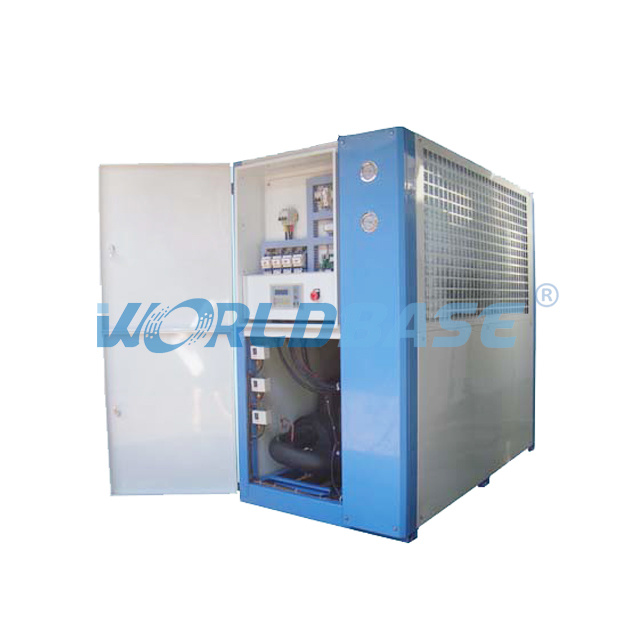
Water chiller manufacturing has moved far beyond simply bolting together compressors and heat exchangers. On today's factory floors, the entire thermal design gets questioned from first principles—evaporator geometries, refrigerant distribution, and baffle placement are reworked to squeeze out inefficiencies that older designs tolerated. That mindset carries into fabrication, where automated orbital welding and laser alignment ensure every joint meets tight dimensional tolerances. The payoff shows up when units leave the line and enter test bays built to replicate the worst conditions a plant can throw at them: high ambient heat, fouled water, sudden load swings, and extended duty cycles. Instead of hoping a prototype survives, engineers now watch full production units prove themselves under stress before they ever reach a customer's loading dock.
Customization has also become less of a special-order headache. Chillers are now assembled around modular frame and piping kits that accommodate unusual thermal loads—think plating lines, laser cutters, or chemical reactors—without forcing a full redesign. On the control side, the push is toward straightforward interfaces that still deliver adaptive sequencing, variable-speed logic, and alarm triage. Operators get useful diagnostics rather than a wall of raw data. And because downtime is expensive, serviceability is designed in from the start: hinged panels, tool-free filter access, quick-disconnect fittings, and common spare parts across the product range. The result is a cooling system that doesn't just work on paper—it stays dependable in real industrial environments and gets back online fast when maintenance is needed.
Contact Us
Contact Person: Mr Yang
Email: [email protected]
Tel/WhatsApp: +8613809083091
Website: https://en.worldbase.cn